

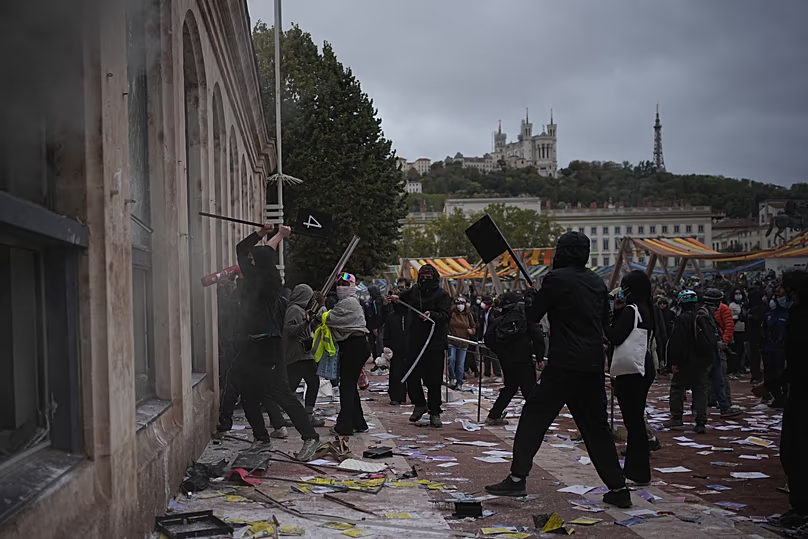

On Saturday, October 17, France lost control of its streets. What began weeks earlier as student protests over teacher shortages and crumbling schools, and grew into nationwide marches over the cost of living, turned into a wave of looting across Paris, Lyon, Marseille, Bordeaux, Lille, Rennes, Strasbourg, Grenoble, Nice and other cities. The looting resumed Sunday night.
France was not caught unprepared in the usual sense. The government deployed about 60,000 police, gendarmes and other security personnel. But intelligence officials expected roughly 200,000 demonstrators, and about 550,000 showed up. Interior Minister Laurent Nuñez admitted police numbers fell short and that authorities “lost control” in some major cities. Justice Minister Gérald Darmanin was blunter: “We unquestionably failed.”
The criminals saw their opening and took it. While police were tied down at the marches, groups of masked looters, many dressed in black, moved quickly through commercial districts. They smashed windows, pried metal security shutters until they gave way, and stripped shelves. Nuñez blamed “hordes of troublemakers and looters” and conceded police tactics must adapt to “extremely mobile groups.” In some cities, police simply could not stop looters moving from store to store.
What they hit tells you what looters want when order breaks down:
- Food. Supermarkets were prime targets. Carrefour’s CEO said 50 shops in its network were targeted, and Franprix and Monoprix grocery stores were hit too.
- Phones, electronics and gold. Apple stores were looted in Lille and Bordeaux, mobile phone shops were stripped, and a gold-buying shop near Paris’s Place de la République was cleaned out. “They’d taken everything,” the owner said.
- Luxury goods. Dior, Céline, Louis Vuitton and Hermès boutiques were ransacked in Paris and Marseille.
- Anything else of value, from wine shops and vape shops to sporting goods stores.
By one major retailer’s estimate, about 1,500 businesses were hit, at a cost of several hundred million euros. The Paris chamber of commerce counted at least 300 businesses vandalized in Paris alone. Rioters also burned public buildings; in Limoges, the 19th-century city hall, which survived both World Wars, was set ablaze and its roof collapsed. About 2,400 people were arrested, and more than 600 police officers, gendarmes and firefighters were injured on Saturday alone.
The big chains will recover. Many small owners may not. In Paris, a man named Hassan was filmed holding his head in despair after looters emptied the mobile phone shop he had opened just three months earlier. Another owner near Place de la République said he had put all his savings into his shop and lost everything. Neighbors started fundraisers to keep them afloat.
Some shopkeepers and residents fought back. In Nice, a video-game store employee stood in his doorway to block looters and was kicked in the back and pelted with objects. In Paris, a woman drove looters off with what appeared to be an iron bar, and a resident poured hot water from his window onto looters attacking the optician’s shop below. Employees of a phone shop in Mulhouse fought off people trying to break in. A Euronews film crew was assaulted by looters near Place de la République.
Remarkably, no one was killed. The French Prime Minister called that “a miracle.” Luck is not a plan. During France’s 2023 riots, a young man died after falling from a supermarket roof during looting near Rouen, and the U.S. has its own history of shop owners forced to defend their businesses with rifles, as Korean-American merchants did on Los Angeles rooftops in 1992.
The lesson for preppers
Everything that went wrong in France happened under the best possible conditions. The power was on. Phones and the internet worked. Police and firefighters had their full numbers, their radios, their vehicles and their fuel. Courts and jails were open. The unrest was largely limited to one weekend and a few city centers. And the state still lost control.
Now picture the same dynamic after a long grid-down event, an economic collapse that wipes out savings and stops paychecks, or a major cyberattack that cripples payment systems, communications and supply chains. Police would be overwhelmed from day one, and many would stay home to protect their own families. There would be no 911, no surveillance video to identify looters later, and no insurance payout. The criminals who emptied French stores in an afternoon would not stop after one weekend. And once the stores are empty, the marauders turn to homes, farms and anyone known to have food, fuel and supplies.
France got a warning of the cyber threat just days before the riots. On October 12, Paris prosecutors announced a large-scale cyberattack that raised refrigerator and freezer temperatures to as high as 122°F (50°C) in hundreds of French supermarkets overnight, spoiling food and causing fires. It is not hard to imagine an attack like that, at scale, setting off exactly the kind of looting France just saw.
Don’t count on police to protect you in a collapse. They couldn’t in France with every advantage. Security in a real disaster comes from numbers, organization, training and preparation: a defensible location, a group you trust, and the means to deter and repel looters before they reach your door. A lone family, or a shop owner with an iron bar, is no match for a mobile gang. The time to build that security is now, while the lights are still on.


